FinMRI: an MRI-style health check for any US stock
A virtual hedge-fund team of AI agents that turns market, news, sentiment and fundamental data into a full-picture risk read, built for understanding what you hold rather than chasing signals.
The problem
Most quant tools emit buy/sell signals. That's not what most investors actually need. If you're weighing an equity, or already holding one you don't fully understand, you want a clear answer to one thing: where does this stock stand right now, and what are the honest arguments on both sides?
FinMRI is built for that question. The name says what it is: an MRI for a stock, a diagnostic scan rather than a trading tip.
What it does
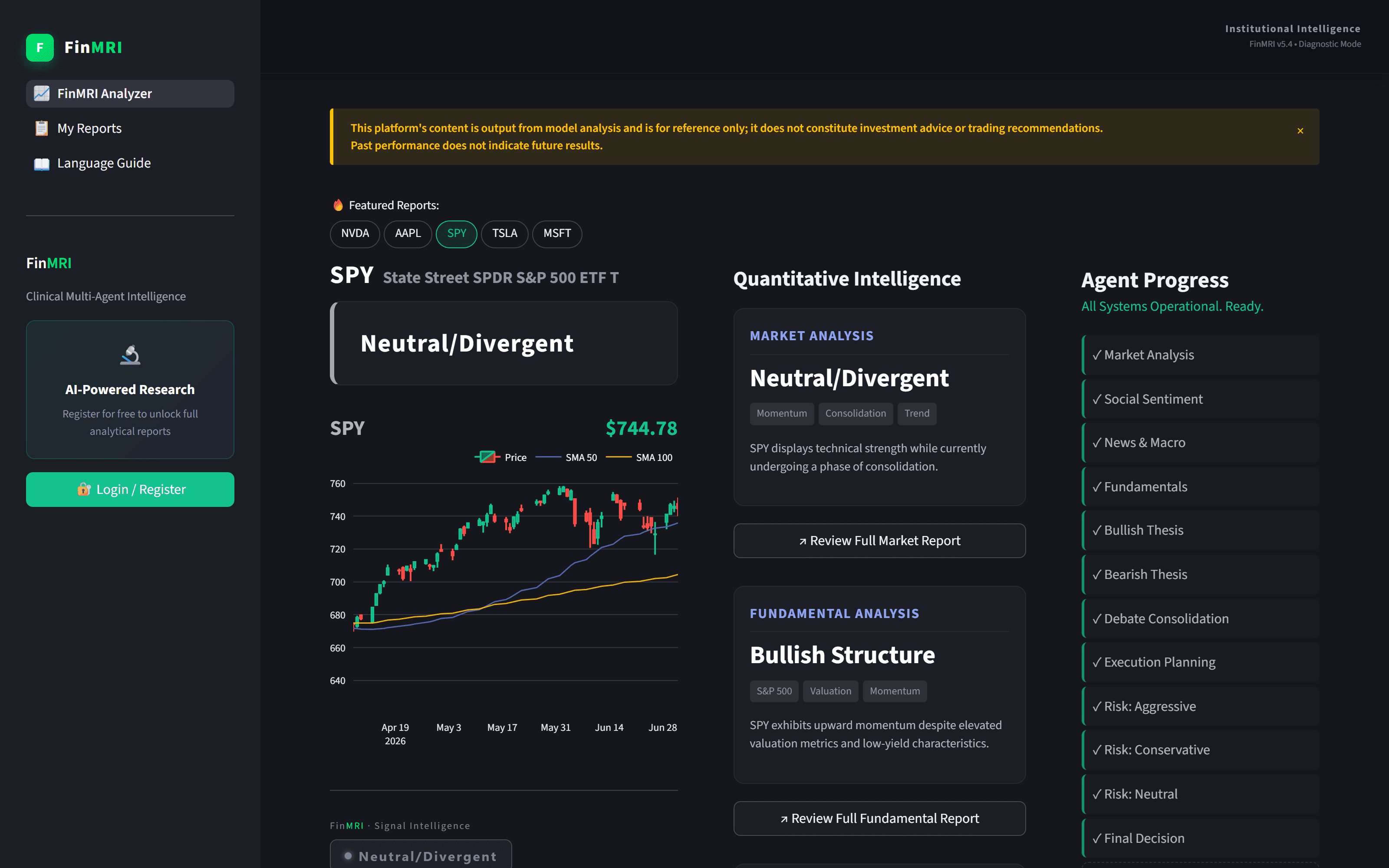
FinMRI assembles a virtual hedge-fund team of collaborating AI agents and runs a full analysis pipeline on any US stock:
- Analysts gather market, news, social-sentiment and fundamental data.
- Bull vs. bear debate runs several rounds of structured argument between opposing analyst theses, then a consolidation pass weighs both sides.
- A trader translates the consolidated view into execution planning.
- The risk team reviews the plan from aggressive, conservative and neutral perspectives.
- The portfolio manager is a final decision layer that produces the comprehensive risk read.
Every stage is visible to the user as the pipeline runs. The output is a full-picture, attributable assessment for medium- and long-term investors, not a black-box score.
How it's built
The agent team is orchestrated with LangGraph, with LangChain and RAG feeding grounded context into each agent's reasoning, behind a FastAPI service layer. It runs as a multi-user web platform (accounts, saved reports, featured analyses) that anyone can open in a browser rather than a command-line tool they have to set up themselves.
Design decisions
- The orchestration is built from the underlying tools rather than wrapping a black box, so when something misbehaves in front of a user I can see why.
- Explicit bull and bear theses before consolidation produce more honest output than asking one model for "an analysis."
- The unglamorous parts (multi-user auth, report persistence, rate-aware data ingestion, clear disclaimers) are what make it usable by strangers, not just a demo.